The European Erasmus+ project Superhero School: Imagining an Inclusive and Digital Education System Adapted to Students with Cancer, coordinated by Fundació La Nineta dels Ulls, continues to make progress in developing resources to promote a more inclusive education system adapted to the needs of children and adolescents with cancer.
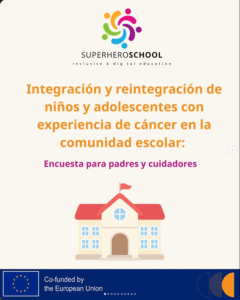
One of the project’s most significant developments is the presentation of the initial results of the study on families’ educational experiences, which has already involved 275 families from Spain and Greece. Their responses are helping to identify needs, challenges and experiences related to education during cancer treatment and the return to school.
The survey remains open to encourage further participation and enrich the results of the study. These findings will provide a valuable foundation for developing educational tools and approaches that respond to the real needs of students and their families.
A New Meeting of All European Partners
This month, a new online coordination meeting was also held with the participation of all project partners: Karkinaki and Leonteios Sxoli, from Athens; Smallcodes, from Florence; RedTree, from Valencia; Escola PAX, from Tarragona; and Fundació La Nineta dels Ulls, the project coordinator.
During the meeting, the different working groups shared progress across the main areas of Superhero School: the new version of the project website, the results of the family survey, the proposals for curriculum adaptations, and the guide for Superhero Schools.
The meeting also provided an opportunity to plan the next stages of the project and coordinate the tasks of the different partners as work on the project’s outcomes continues.
With each new step, Superhero School is turning the experiences and needs of families, students and the educational community into practical resources that can help schools provide better support for children and adolescents with cancer.
Together with our European partners, we continue working towards a more inclusive and digital education system that is better prepared to support students with cancer.